Mansell Recruitment Group Ltd
Mansell House
Priestley Way, Crawley
West Sussex, RH10 9RU
United Kingdom


Fill in your details below, upload your CV and one of our consultants will be in touch to discuss relevant opportunities.
Mansell Recruitment is the gold standard in engineering recruitment. Our specialist team has a deep understanding of sourcing top talent, so reach out and discover how we can join forces to find your next hire.
Mansell Recruitment Group Ltd Mansell House Priestley Way, Crawley West Sussex, RH10 9RU United Kingdom

Securing Engineering Jobs in the UK: A Complete Guide
roles, understanding how to navigate the market is key to success. With increasing demand for specialist skills and ongoing innovation across industries, securing engineering jobs in the UK requires a strategic, informed approach.
In this guide, we explore the most in-demand sectors, the skills employers are prioritising, and how to position yourself effectively through tailored applications and the right support networks.
Engineering continues to play a vital role in the UK economy, with demand spanning traditional manufacturing through to cutting-edge technologies such as automation and robotics. As industries evolve, so too does the need for highly skilled professionals who can adapt to new systems, tools and methodologies.
Mechanical engineer jobs remain a cornerstone of the sector, particularly within manufacturing and production environments. However, there has also been a noticeable rise in demand for professionals within electronics, software engineering, and controls and automation. This shift reflects the broader move towards digitalisation and smart manufacturing.
At the same time, companies are placing greater emphasis on innovation, sustainability and efficiency. This has created opportunities not only for experienced engineers but also for those entering graduate engineering careers, particularly individuals who can demonstrate a strong foundation in both technical and transferable skills.
While opportunities exist across the board, certain sectors are currently experiencing particularly strong growth. Manufacturing and production continue to require skilled engineers to maintain quality and efficiency, especially as companies strive to remain competitive in a global market.
Design and development is another key area, with organisations investing heavily in research and innovation to bring new products to market. Engineers who can contribute to product lifecycle development, from concept through to production, are highly sought after.
The rise of automation has also significantly increased demand for professionals in controls and robotics. As businesses transition towards smarter, more autonomous systems, engineers with expertise in programming, system integration and maintenance are becoming essential.
Additionally, the electronics and software sector continues to expand, driven by advancements in embedded systems, IoT and digital technologies. This has opened up new pathways for both experienced professionals and those entering graduate engineering careers.
To secure engineering jobs in the UK, candidates must demonstrate more than just technical knowledge. While qualifications and experience remain important, employers are increasingly seeking well-rounded professionals who can contribute to broader business objectives.
Technical competence is, of course, fundamental. For those pursuing mechanical engineer jobs, this may include proficiency in CAD software, knowledge of manufacturing processes, and an understanding of materials and design principles. In other disciplines, programming languages, systems integration or electronics expertise may be required.
However, soft skills are equally critical. Communication, problem-solving and teamwork are highly valued, particularly in collaborative engineering environments. Engineers are often required to liaise with multiple departments, including production, sales and management, making the ability to convey complex ideas clearly a significant advantage.
Adaptability is another key trait. With technology evolving rapidly, employers favour candidates who are willing to learn and stay up to date with industry developments. This is especially important for those at the beginning of their graduate engineering careers, where a proactive approach to professional development can set candidates apart.
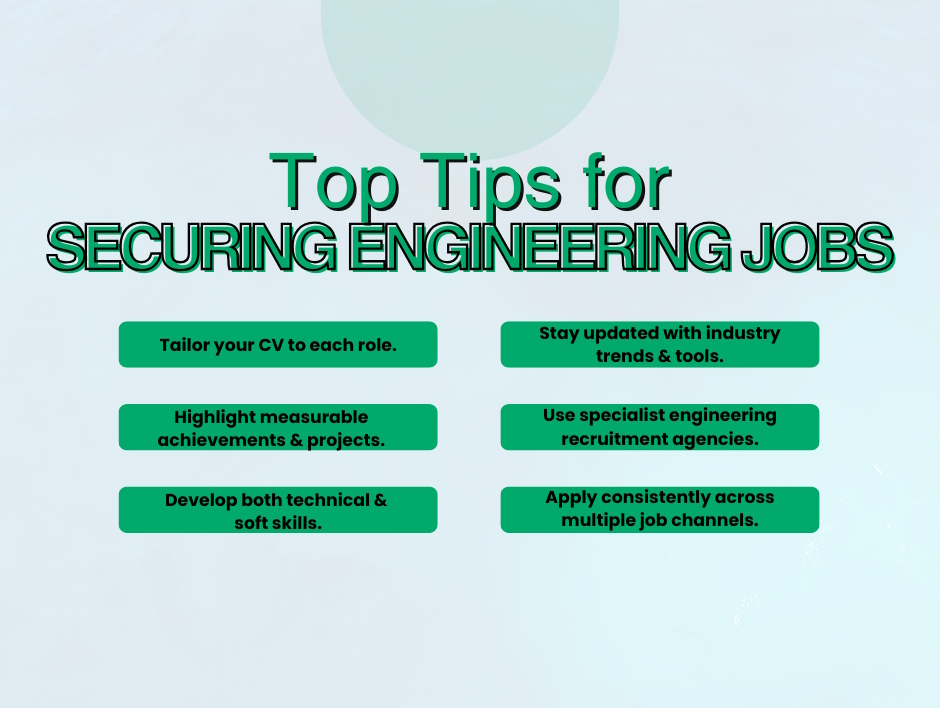
A well-structured CV is one of the most important tools when applying for engineering jobs in the UK. Employers typically review applications quickly, so it is essential to make a strong impression from the outset.
Your CV should clearly highlight relevant experience, technical skills and achievements. Rather than listing responsibilities, focus on measurable outcomes where possible. For example, detailing how you improved efficiency, reduced costs or contributed to successful project delivery can make your application more impactful.
It is also important to tailor your CV to each role. Different engineering positions will prioritise different skills, so aligning your experience with the job description can significantly improve your chances of success. For those applying to mechanical engineer jobs, emphasising hands-on experience and technical expertise will be key, while roles in software or electronics may require a stronger focus on programming and systems knowledge.
Clarity and structure are equally important. A concise, easy-to-read format ensures that hiring managers can quickly identify your strengths and suitability for the role.
Beyond the CV, your application should demonstrate a clear understanding of the role and the organisation. Employers want to see genuine interest and a strong alignment between your skills and their requirements.
A tailored cover letter provides an opportunity to expand on your experience and explain why you are the right fit. This is particularly important for those entering graduate engineering careers, where practical experience may be limited. Highlighting academic projects, placements, or relevant coursework can help bridge this gap.
Research is essential. Understanding the company’s products, services and market position allows you to position yourself more effectively. It also shows initiative and enthusiasm, qualities that are highly valued by employers.
Working with a specialist engineer recruitment agency can significantly enhance your job search. Recruitment experts have in-depth knowledge of the market and access to opportunities that may not be advertised publicly.
At Mansell Recruitment Group, we specialise in recruiting engineers across a wide range of sectors, from manufacturing and design through to electronics and automation. With decades of experience, we understand what employers are looking for and can provide valuable guidance throughout the application process.
Partnering with an experienced agency not only increases your access to relevant roles but also ensures that your applications are aligned with industry expectations. This can be particularly beneficial for candidates navigating the competitive landscape of engineering jobs in the UK.
In addition to working with an engineer recruitment agency, it is important to explore multiple channels when searching for roles. Online job boards remain a popular starting point, offering a wide range of engineering jobs across the UK.
However, not all opportunities are advertised publicly. Many companies rely on recruitment agencies or internal networks to source candidates. This makes it essential to build connections within the industry and stay proactive in your job search.
For those pursuing graduate engineering careers, university career services, internships and networking events can also provide valuable entry points into the industry.
Securing a role is only the first step. Building a successful engineering career requires ongoing development and a commitment to continuous learning. Staying up to date with industry trends, gaining additional qualifications and seeking new challenges can help you progress and remain competitive.
It is also important to consider your long-term goals. Whether you aim to specialise in a particular discipline, move into management or explore new sectors, having a clear direction can guide your career decisions.
The UK engineering sector offers a wealth of opportunities for those with the right skills, mindset and approach. By understanding the market, tailoring your applications and leveraging the support of a specialist engineer recruitment agency, you can significantly improve your chances of securing the right role.
At Mansell Recruitment Group, we are committed to helping candidates at every stage of their journey, from graduate engineering careers through to senior leadership positions. If you are ready to take the next step in your engineering career, get in touch with our team today and discover how we can support your success.
Mansell Recruitment Group Ltd
Mansell House
Priestley Way, Crawley
West Sussex, RH10 9RU
United Kingdom
recruitment@mansell.co.uk
T: 01293 404050


